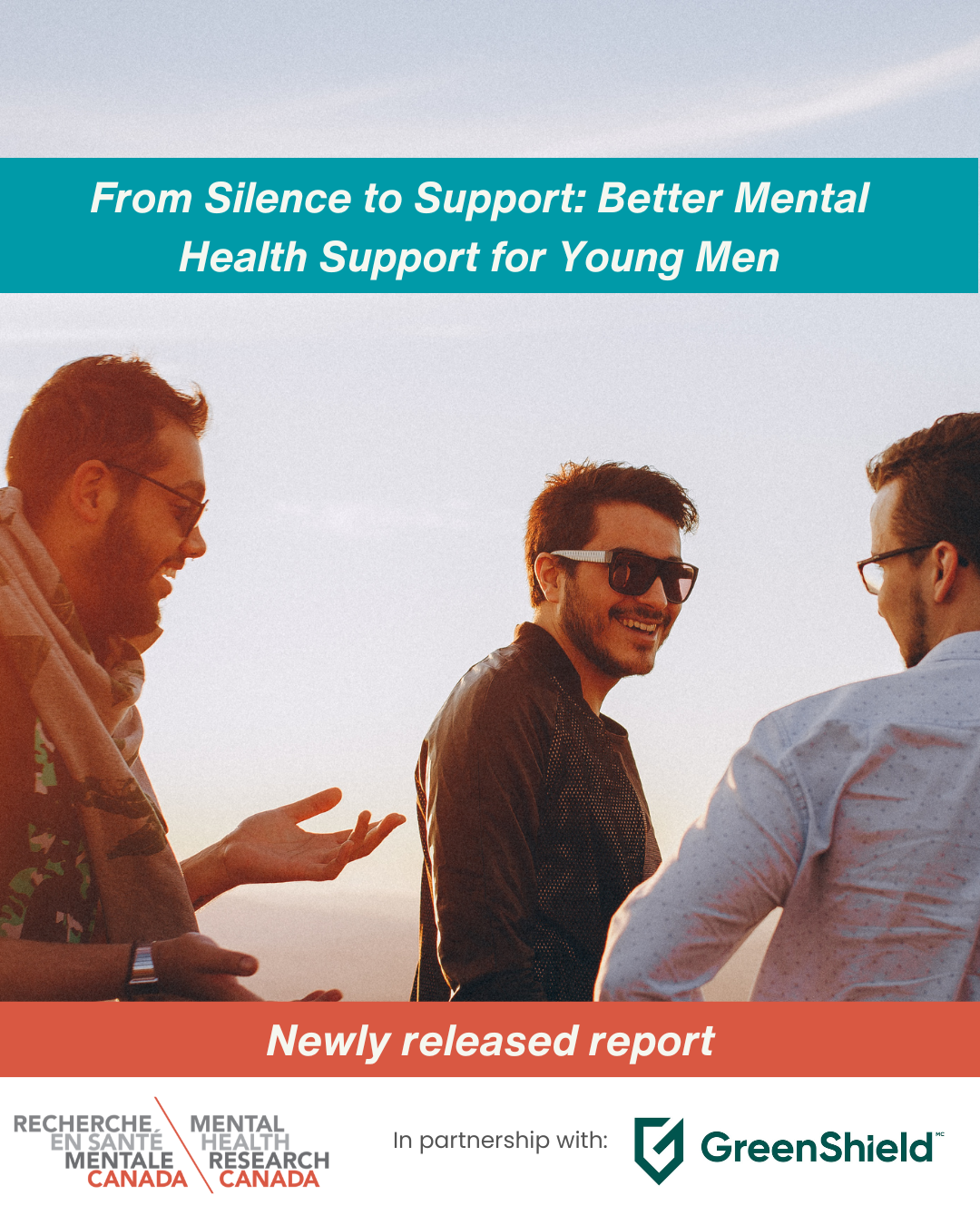
From Silence to Support:
Better Mental Health Support for Young Men
View mental health challenges as weakness
Needed support but did not access it
Disengaged before their needs were met
33%
44%
49%
New findings show why improving mental health support for young men must go beyond access alone.
Our new report, developed in partnership with GreenShield, examines the mental health needs of young men aged 16 to 29, including their help-seeking behaviours, the coping strategies they may use instead of seeking help and what they need when they do access support.
As Canada looks more closely at the distinct health challenges facing men and boys, our data point to the need for earlier, evidence-based mental health support and systems that make it easier to seek help when it is needed.
June 10, 2026
Young Men · Youth · Help-Seeking · Stigma · Access to Care · Care Continuity · Engagement · Barriers to Care · Coping · Responsive Support · Choice and Control · Equity and Inclusion
About the report
The data in this report draw on MHRC data from the national population polling initiative, Understanding the Mental Health of Canadians. The online survey was conducted from February 4 to 20, 2026, among a sample of 3,519 adult Canadians. It was a blind study, meaning that participants were unaware of the subject matter before beginning the survey.
We thank GreenShield for its partnership in developing this report.
Key findings
Stigma and disengagement
One in three young men view asking for help for mental health challenges as a sign of weakness.
Forty-four per cent of young men who needed support last year did not access it.
Among those who did access care, 49 per cent disengaged earlier than planned or before their needs were fully met.
Riskier coping behaviours
Young men are three to four times more likely to indicate problematic substance use than people older than 55.
They are also 12 times more likely to indicate problematic gambling behaviours compared to those older than 55.
Gambling risk among young men is roughly double the national average.
Equity-seeking communities
The report also explores how barriers differ across equity-seeking populations, including racialized young men, newcomers, Indigenous young men and 2SLGBTQIA+ youth. These findings point to the need for support that reflects lived experiences, cultural contexts and pathways to care.
Racialized young men are less likely to turn to family and friends when struggling: 54 per cent would, compared with 68 per cent for non-racialized young men.
They are also more likely to talk to no one: 29 per cent compared with 15 per cent for non-racialized young men.
Young men who are new to Canada are more likely to view seeking mental health support as a personal weakness: 50 per cent, compared with 34 per cent of those whose parents were immigrants and 28 per cent of those who are at least second-generation Canadians.
Why this matters
Access alone is not enough.
The findings show that mental health support is also an engagement challenge. Services must be designed in ways people can recognize, trust, use and continue using, or they may continue to miss those they are intended to reach.
The report points to the need for gender-informed, evidence-based and youth-informed approaches that address stigma, improve engagement and better reflect the needs of young men, including those from equity-seeking communities.