Mental Health and Substance Use in Canadian Households: Does Composition Matter?
This report explores how different forms of household composition are associated with mental health and substance use outcomes among Canadians.
MHRC’s quarterly tracking has shown that an individual's caregiving responsibilities at home could be associated with a decline in their mental well-being, a trend that became particularly pronounced during the COVID-19 pandemic.
By examining the makeup of a household and the caregiving roles within it, we assess how these factors are associated with mental health and substance use indicators.
Key findings:
Those in “sandwich generation” households are more likely to experience moderate to severe anxiety compared to those living alone. Single-parent families and two-parent families also have higher odds of anxiety than those living alone.
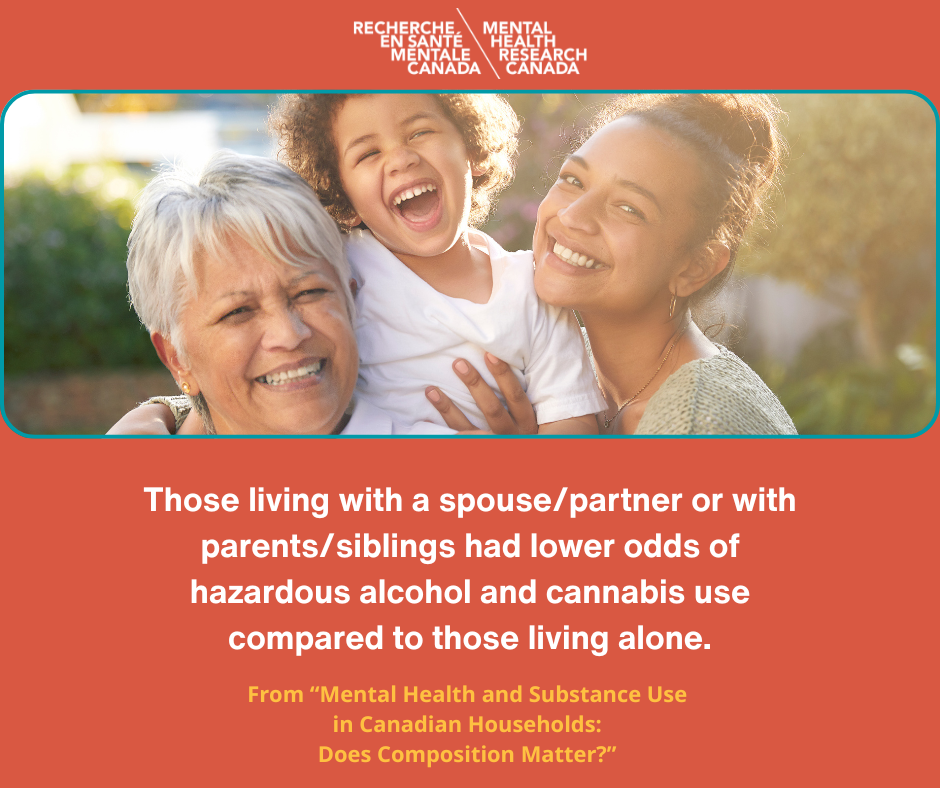
Living with a spouse/partner or with parents/siblings has lower odds of hazardous alcohol and cannabis use compared to those living alone.
Living with roommates is associated with higher odds of hazardous alcohol and cannabis use, and those in sandwich generation households have higher odds of hazardous cannabis use.
ABOUT THE REPORT
The report presents data from MHRC's partnership with Pollara Strategic Insights during our national mental health polling initiative. This data represents 30,106 respondents aged 16 and older, who answered questions about their mental health in an online survey. This was a blind survey, meaning that respondents were not informed of the subject matter before starting.
A collection of our previously released research briefs providing an in-depth investigation of our polling results can be found here.